


Calm the Chaos and Create! The Basics of Brainstorming
Posted by [email protected] on May. 8, 2022 / Subscribe 0

BRAINSTORMING
Brainstorming is a simple technique used to generate a list of ideas. A divergent thinking tool useful for idea generation on a given subject in a limited period.
Using interpersonal and team skills, this data gathering technique is used to identify a list of ideas in a short period of time. Used to generate and collect multiple ideas related to project and product requirements. Brainstorming is a general data-gathering and creativity technique that can be used to solve problems, identify risks, ideas, or solutions to issues by using a group of team members or Subject Matter Experts (SMEs).
Brainstorming is typically conducted in a facilitated session or workshop environment to stimulate creative thinking, to create novel or innovative solutions to a problem, and to introduce “controlled chaos” into the thought process. It is a widely used technique for idea cultivation.
It should be led by a facilitator with a group consisting of stakeholders, team members, and Subject Matter Experts (SMEs). Brainstorming comprises two parts: idea generation and analysis. After quickly generating a list of alternatives, the group then performs analysis of the alternatives and generally chooses a particular option for action. The list can be prioritised by combining brainstorming with dot voting to have the team assess a list of alternatives, and then quickly decide where to focus their attention.
The objective is quantity, not necessarily quality and is based on the principle that “many brains are often better than one.”
BRAINSTORMING RULES
(Communicate the rules!) It is conducted in a group environment and is led by a facilitator. No comment or criticism of any ideas is allowed. This is the suspended judgement principle of brainstorming. However, asking for clarification is allowed. Don’t censor your own ideas. Just as criticism may discourage others from contributing, self-criticism may censor your ideas. Present whatever crazy-idea pops into your mind.
Encourage humour and fantasy. Make it fun! If the team is laughing = this is good! We are at our creative best!
Brainstorming is no place for reality: it’s a place for imagination, for the free flow of thoughts and ideas.
Quantity not quality, the more ideas the better. Don’t worry about how good the ideas are; just think of as many as possible.
Piggyback on others ideas, build upon each other’s ideas. Often, other people’s ideas make you think of a completely new set of ideas.
Diversity of participants is important. Different perspectives for different ideas. (Age, gender, education background, role in project, etc.)
Great tools are: Slido, or Post-It notes on a wall with lots of colours (one per participant), and mind mapping.
A technique used to integrate ideas created through individual brainstorming sessions into a single map to highlight similarities and differences in understanding and generate new ideas.
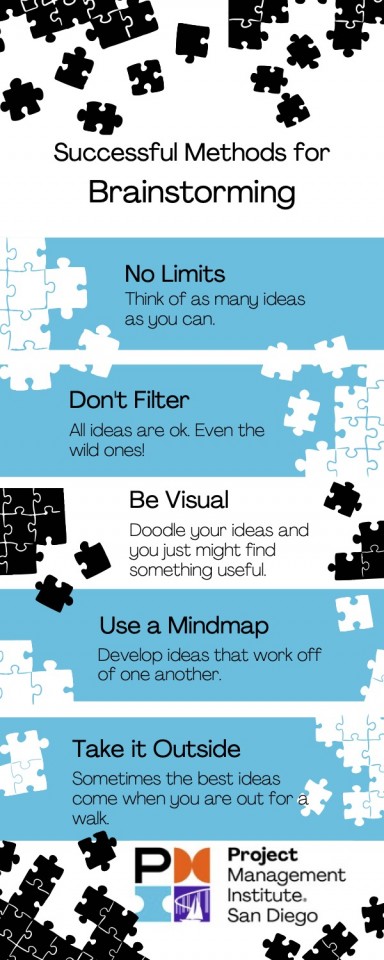
Don't forget to check out our Brainstorming Infographic!

0 Comments